
The Discourse of “Russophobia” as a Kremlin Propaganda Tool

Recently, representatives of Georgian Dream have increasingly invoked the discourse of “Russophobia” in Georgia. For example, on 14 September this year, in an interview broadcast on Rustavi 2, Irakli Kobakhidze said that “calling Russophobia by its name” was part of the government's efforts, while the concept of “Russophobia” itself was a tool for combating it. Furthermore, according to Kobakhidze, it is precisely the “agents” who dislike the term “Russophobia” and its use because, as he put it, they want to “kill” not Russophobia, but the very concept itself. Kobakhidze also noted that the government’s objective was to eliminate Russophobia at its very inception. Against the background of this statement, the concept of “Russophobia” has become another important issue in Georgia’s ongoing political discourse. Accordingly, it is relevant to examine what this term means, its historical and academic definitions, and how it is used in contemporary political and information discourse.
According to the European External Action Service’s East StratCom Task Force, in the absence of credible arguments, the term “Russophobia” has evolved into a widely used label employed by the Kremlin to dismiss criticism of its policies and actions. This narrative became particularly prominent following Russia’s annexation of Crimea in 2014 and its full-scale invasion of Ukraine in 2022. This approach portrays Russia as a victim while simultaneously sidestepping the issue of Moscow’s responsibility for its aggression and violations of international law. According to the independent Russian-language online publication Meduza, the Russian authorities not only use the concept of “Russophobia” for propaganda purposes but also actively promote its spread.
Figure 1. Accusations of Russophobia in the Public Communications of the Russian Ministry of Foreign Affairs (2000-2018)
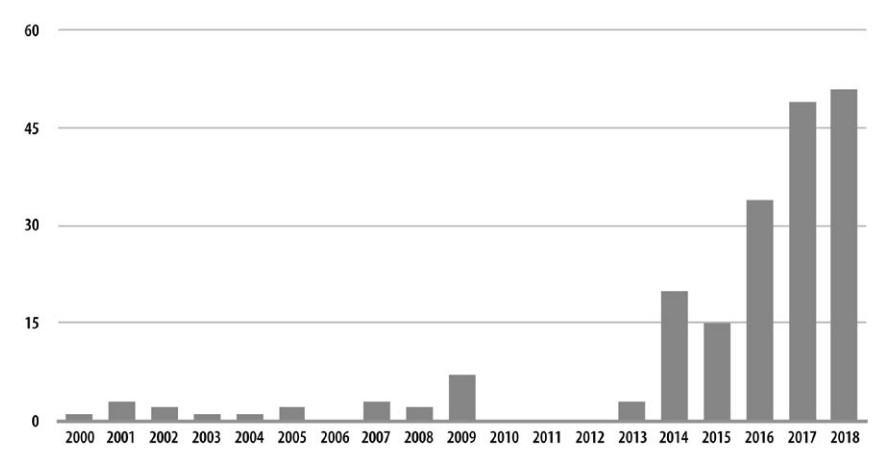
Source: Neil Robinson (2019), “Russophobia” in Official Russian Political Discourse.
Note: The data are based on information published on the website of the Russian Ministry of Foreign Affairs (www.mid.ru) between 1 January 2000 and 17 September 2018.
The Kremlin’s propaganda uses the term “Russophobia” in a much broader sense than xenophobia. An examination of information published on the Russian President’s website (Kremlin.ru) revealed that the word “Russophobia” first appeared in Vladimir Putin’s speeches in 2014. Since then, Kremlin representatives have increasingly used the term, labelling criticism of the Russian authorities over the occupation of neighbouring countries, their intimidation, human rights violations within Russia, or the persecution of the opposition as “Russophobia”. In particular:
- On 17 April 2014, the spokesperson for the Russian Ministry of Foreign Affairs described the European Parliament resolution concerning the third stage of sanctions against Russia as “a collective Russophobic psychosis experienced by the current composition of the European Parliament”.
- In 2015, Konstantin Kosachev, Chair of the International Affairs Committee of the Federation Council of the Russian Federation, called the authors of a Parliamentary Assembly of the Council of Europe (PACE) resolution “Russophobes” after they referred to Russia as an aggressor and described its annexation of Crimea as an “occupation”.
- In 2016, Dmitry Peskov, the Russian President’s Press Secretary, described US President Barack Obama’s comments about Putin as “blatant Russophobia”. Obama had criticised the Russian President for controlling the media and imprisoning political opponents in the country, and had compared him to Saddam Hussein.
- In 2017, Peskov responded to a statement by US Vice President Joe Biden that Russia was trying to intimidate weaker countries, stating: “Russia has never intimidated anyone; it has always been a reliable and predictable partner. It has absolutely failed to understand the hysterical, emotional, Russophobic atmosphere that is often imposed from outside on our neighbouring states, whether the Baltic countries or Eastern Europe. We are interested in establishing good relations with these countries and sincerely fail to understand why they give in to these hysterical, Russophobic sentiments that are skilfully encouraged from outside.”
- On 12 March 2019, Peskov described the US House of Representatives’ approval of four bills, one of which required the US Director of National Intelligence to submit a six-month report on Vladimir Putin’s income, as “a continuation of an unfriendly and unrestrained Russophobic line”. He also noted that the intensity of Russophobia would increase as the presidential election approached.
Between 2014 and 2019, Vladimir Putin himself used the word “Russophobia” publicly at least 10 times, seven of which occurred in 2018. Among other instances, following the poisoning of former Russian military intelligence officer Sergei Skripal and his daughter, Yulia Skripal, in the United Kingdom, Putin described the imposition of sanctions against Russia as a “politicised Russophobic approach”.
During the same period, Kremlin representatives also made statements concerning “Russophobia” in the context of Georgia. In particular, in June 2019, the Russian President’s Press Secretary described the protests taking place outside the Parliament of Georgia as a “Russophobic provocation”. In July of the same year, the Russian Ministry of Foreign Affairs called TV host Giorgi Gabunia’s use of offensive language about Vladimir Putin on the Georgian television channel Rustavi 2 a “clear example of Russophobia”.
From 2024 to the present, 272 statements have been published on the website of the Russian Ministry of Foreign Affairs as “Examples of statements by Western officials and elite representatives employing hate speech against Russia”. These statements belong to representatives of 25 countries, as well as the European Union, NATO, and the Parliamentary Assembly of the Council of Europe. The countries whose officials’ statements are included among the examples of “Russophobia” are: the United States, Belgium, Bulgaria, the United Kingdom, Germany, Denmark, Estonia, Ireland, Iceland, Italy, Canada, Cyprus, Latvia, Lithuania, Luxembourg, the Netherlands, Norway, Poland, Romania, Greece, France, Finland, Sweden, the Czech Republic and Croatia.
Figure 2. Number of Statements Cited by the Russian Ministry of Foreign Affairs as Examples of Russophobia, by Country and International Organisation (January 2024 – August 2026)
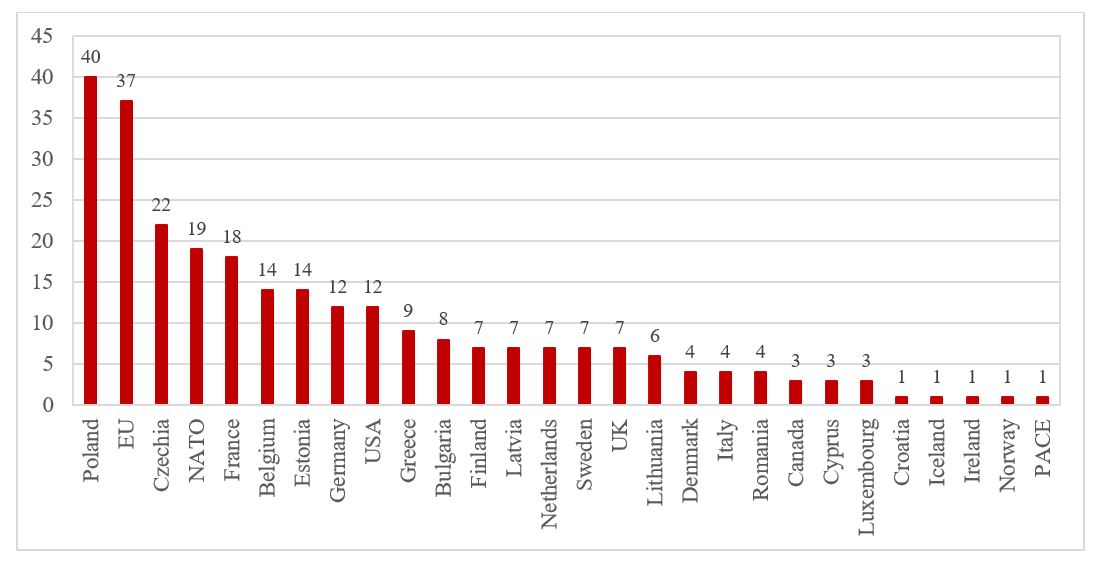
Source: www.mid.ru
The statements most frequently cited by the Russian Ministry of Foreign Affairs as examples of “Russophobia” are those made by Kaja Kallas, Vice-President of the European Commission and the EU’s High Representative for Foreign Affairs and Security Policy. She is followed by former Czech Foreign Minister Jan Lipavský, former Polish President Andrzej Duda, NATO Secretary General Mark Rutte, French President Emmanuel Macron, and other officials.
Table 1. Number of Statements Cited by the Russian Ministry of Foreign Affairs as Examples of Russophobia, by the Most Frequently Mentioned Officials (January 2024 – August 2026)
|
No. |
Official |
Number of statements |
Position |
|
1 |
Kaja Kallas |
18 |
Vice-President of the European Commission and EU High Representative for Foreign Affairs and Security Policy; Prime Minister of Estonia (2021-2024) |
|
2 |
Jan Lipavský |
13 |
Minister of Foreign Affairs of the Czech Republic (2021-2025); currently a member of the Chamber of Deputies of the Czech Parliament |
|
3 |
Andrzej Duda |
11 |
President of Poland (2015-2025) |
|
4 |
Mark Rutte |
11 |
NATO Secretary General; Prime Minister of the Netherlands (2010-2024) |
|
5 |
Emmanuel Macron |
10 |
President of France |
|
6 |
Jens Stoltenberg |
8 |
NATO Secretary General (2014-2024) |
|
7 |
Karol Nawrocki |
8 |
President of Poland |
|
8 |
Margus Tsahkna |
8 |
Minister of Foreign Affairs of Estonia |
|
9 |
Radosław Sikorski |
8 |
Minister of Foreign Affairs of Poland |
|
10 |
Josep Borrell |
7 |
EU High Representative for Foreign Affairs and Security Policy (2019-2024) |
|
11 |
Donald Tusk |
6 |
Prime Minister of Poland |
|
12 |
Annalena Baerbock |
5 |
Minister of Foreign Affairs of Germany (2021-2025); currently President of the United Nations General Assembly |
|
13 |
Hadja Lahbib |
5 |
Minister of Foreign Affairs of Belgium (2022-2024); currently European Commissioner for Preparedness and Crisis Management |
|
14 |
Kęstutis Budrys |
5 |
Minister of Foreign Affairs of Lithuania |
|
15 |
Kyriakos Mitsotakis |
5 |
Prime Minister of Greece |
|
16 |
Petr Pavel |
5 |
President of the Czech Republic |
|
17 |
Stéphane Séjourné |
5 |
Minister for Europe and Foreign Affairs of France (2024); currently Executive Vice-President of the European Commission for Prosperity and Industrial Strategy |
|
18 |
Ursula von der Leyen |
5 |
President of the European Commission |
|
19 |
Alexander De Croo |
4 |
Prime Minister of Belgium (2020-2025) |
|
20 |
Baiba Braže |
4 |
Minister of Foreign Affairs of Latvia |
According to reports published by the Russian Ministry of Foreign Affairs, virtually any criticism of Russia is classified as Russophobia and hate speech. Examples of such statements include the following quotes by Western leaders:
- Minister of Defense and Foreign Trade of Belgium Theo Francken: "The tough resistance against the Russian shadow fleet is of crucial importance. What France did and what the US is doing now is good. Oil trade is Moscow's Achilles' heel. Without oil revenues, there would be no war." (Posted on X platform, January 8, 2025)
- British Secretary of State for Defence John Healey: "As we enter the fifth year of Putin’s illegal war in Ukraine, we’re stepping up the pressure on Putin, by choking off the funds that fuel his invasion and targeting Shadow Fleet vessels. I’m proud of the UK’s leading role in JEF, as we step up together to tackle the threats we face in this new era." (During the meeting of the member countries of the Joint Expeditionary Force, March 11, 2026)
- Minister of Defence of Germany Boris Pistorius: “The Black Sea, the Baltic Sea, and the North Atlantic differ fundamentally from one another in terms of their geography and characteristics. Yet they all face the same threat: Russia. Today, this threat does not emerge selectively or sporadically. It runs like a trench across Europe, along the border with Russia, all the way to the far north. From the Black Sea to the Arctic, Russia is seeking to assert its alleged historical claims and establish a sphere of influence.” (Statement delivered at the Kiel Security Conference, June 19, 2026)
- Foreign Minister of Lithuania Kęstutis Budrys: "We were first to complete our internal procedures to join the Special Tribunal in the Hague. It is high time to identify the remaining war criminals inside the Kremlin and outside its walls to bring them to the Hague." (Posted on X platform, March 12, 2026)
- President of Lithuania Gitanas Nausėda: "Respect to UK Prime Minister Keir Starmer for ordering the seizure of a Russian shadow fleet tanker in the English Channel. Well done, Royal Marines, for successfully carrying out the operation today!" (Posted on X platform, June 14, 2026)
- Minister of Foreign Affairs of Norway Espen Barth Eide: "Russia is waging war against Ukraine, but its goal is to destroy the security system in Europe. Russia remains the defining threat to European security, peace, and stability." (Report in the Storting on Norway's foreign policy, March 3, 2026)
- Deputy Prime Minister, Foreign Minister of Poland Radosław Sikorski: "Russia's state ideology celebrates kleptocracy repression and conquest. It is therefore Russia that needs to be de-radicalized." (Comment on X, December 16, 2025)
- President of Romania Nicușor Dan: "We will not allow Russian influence to erode what the citizens of the R. Moldova have chosen – the European path." (Post on the X platform, May 4, 2026)
- Prime Minister of Finland Petteri Orpo: “We approved the 20th sanctions package against Russia at the European Council, and the next one is in preparation. We are striving for broader international cooperation, including beyond the European Union, to curb the activities of Russia’s shadow fleet, which is precisely how Putin fuels his military budget, and much other work is being carried out to weaken Russia while simultaneously strengthening Ukraine.” (Statement in the Finnish Parliament during a discussion on the threat of drones and intergovernmental coordination in this regard, May 21, 2026)
- President of France Emmanuel Macron: "We will continue to intensify pressure on Russia. We must make progress on the alignment of the 20th EU sanctions package, the discussion of which will continue in the coming days. We need to work on a complete ban on maritime services for the export of Russian oil, strengthen our joint efforts against the so-called Russian 'shadow' fleet, and achieve the highest level of coordination on this issue." (Press conference with Finnish President Alexander Stubb, Paris, February 23, 2026)
- Minister of Foreign Affairs of Estonia Margus Tsahkna: "Russia needs to be subjected to intense pressure. The Russian economy is actually not that strong. If the US fully implements the "Graham sanctions package" now, and in addition, Europe adds the 20th sanctions package soon, I believe Russia will face serious problems." (Interview with ERR publication, January 8, 2026)
- High Representative of the European Union for Foreign Affairs and Security Policy Kaja Kallas: "Today, the EU provided the first €10 million for a new Special Tribunal to prosecute Russian leaders for their role in Moscow's war against Ukraine. Russia's leaders are responsible for this war, and they must be held accountable. There can be no impunity." (Posted on X platform, January 22, 2026)
- NATO Secretary General Mark Rutte: "Putin's war machine is churning out military equipment around the clock and Moscow is testing us through airspace incursions, cyberattacks, sabotage and more. And it is not just Russia. China, Iran and North Korea fuel Moscow's war against Ukraine. These countries are preparing for long-term confrontation with us." (Video address to the participants of the NATO Military Committee meeting at the level of Chiefs of Defense, Brussels, January 21, 2026)
The examples presented demonstrate that the Russian Ministry of Foreign Affairs uses the concepts of “Russophobia” and “hate speech” in a manner that substantially departs from the actual meanings of the terms xenophobia and hate speech. Xenophobia refers to an irrational fear or hatred of people originating from other countries or cultures, which often manifests itself in discrimination and social exclusion. According to the definition provided by the UN Special Rapporteur on contemporary forms of racism, xenophobia exists when “individuals are denied equal rights on account of real or perceived geographic origins of the said individuals or groups, or the values, beliefs and/or practices associated with such individuals or groups that make them appear as foreigners or outsiders.” Hate speech, meanwhile, is defined by the Cambridge Dictionary as “public speech that expresses hate or encourages violence toward a person or group based on something such as race, religion, sex, or sexual orientation”. Criticism of a state or its government’s policies, as well as international sanctions imposed on another state because of its war or human rights violations, cannot be considered xenophobia or hate speech.
The statements presented by the Russian Ministry of Foreign Affairs are primarily directed against the Russian state, the Kremlin’s political leadership, Russia’s military policy, the war waged against Ukraine, and the exertion of political and economic pressure on Russia, rather than against the Russian people as a national or ethnic group. These statements do not exhibit hostility towards foreigners characteristic of xenophobia, calls for discrimination on national or ethnic grounds, dehumanisation, or incitement to violence. Accordingly, their classification as “Russophobia” and “hate speech” clearly indicates a tendency in Russia’s official information discourse whereby criticism of the Russian state and its policies is deliberately interpreted and portrayed as hatred towards the Russian people. This approach allows the concept of “Russophobia” to be used as a broad political label through which critical positions towards the Russian authorities are discredited and criticism is presented as an expression of ethnic or national intolerance.
According to EUvsDisinfo, “if there is one word that indicates that a media outlet is clearly pro-Kremlin, it is ‘Russophobia’”. Media outlets such as RT, Sputnik, and Russian state television use this term to justify almost any foreign criticism of Kremlin policies. By accusing Western societies of “Russophobia”, pro-Kremlin propaganda outlets portray criticism of Kremlin policies and actions as irrational.
In the Kremlin’s discourse, a “Russophobe” assumes the image of an ideological enemy, allowing political issues to be presented in categorical and emotionally charged terms. It is also worth noting that Kremlin propaganda accuses not only representatives of Western countries of Russophobia, but even Russian citizens who criticise Vladimir Putin’s regime.
It should also be noted that the existence of a propagandistic narrative about Russophobia does not preclude the possibility of xenophobia directed against Russian citizens or ethnic Russians. However, even when xenophobic characteristics towards them are evident, it is preferable to avoid using the term “Russophobia”, which carries propagandistic connotations and is actively employed by the Kremlin in a much broader sense than xenophobia.