
The Institution of a “District Delegate” for Georgia’s Members of Parliament: Constitutional Compatibility, Electoral Objectives, and Budget Expenses

Executive Summary
This document analyses the institution of a “district delegate” introduced into Georgia’s electoral legislation in 2024, its compatibility with the proportional representation electoral system and the single nationwide multi-member district established by the Constitution, as well as the use of the institution in the 2024 parliamentary elections and its subsequent funding from the state budget.
The analysis shows that, under a proportional system operating in a single nationwide multi-member district, the “district delegate” institution created a parallel mechanism of territorial representation under which the candidate nominated by the party receiving the most votes in a particular territory is granted delegate status. In its logic, this rule resembles a plurality/majoritarian system and raises questions both about its compatibility with the electoral model established by the Constitution and about the rationale for creating the institution.
The document also examines the use of the institution during the 2024 pre-election campaign. Georgian Dream was the only political party to nominate delegate candidates and actively used them to communicate with voters and mobilise electoral support. The functional and political resemblance created between delegate candidates and majoritarian MPs may have had a significant influence on voter behaviour.
After the election, offices were established for delegates to engage with voters, and their activities are funded from the state budget. This analysis describes the functions and costs of these offices and notes that a significant part of their work - organising meetings with voters, examining citizens’ issues, liaising with civic and political organisations, and supporting the delegate’s political activities - is substantively similar to the local organisational activities of a political party. The Parliament of Georgia allocated approximately GEL 13.6 million for these offices in 2025-2026. This raises the question of how far the institution serves the purposes of parliamentary representation and whether state legislative and financial resources are being used to advance the electoral and organisational interests of the ruling party.
Introduction
After a 30-year tradition of using a mixed-member electoral system to form Georgia’s highest representative body, a fully proportional system came into force in 2024. Under the current Constitution of Georgia, Parliament consists of 150 members elected in a single nationwide multi-member district. The electoral legislation also provides for Parliament to be formed on the basis of closed lists. Under this model, voters cast their ballots only for a political party, which has determined in advance the order of candidates on its national list. At the same time, seats are distributed among political associations in proportion to the votes they receive nationwide. Accordingly, an individual territory no longer determines the allocation of a parliamentary seat to a particular electoral subject.
In this context, it is noteworthy that, several months before the transition to a fully proportional electoral system, in May 2024, the Georgian Dream parliamentary majority introduced the so-called “district delegate” institution into the Election Code. The Organic Law allowed political parties registered for the election to designate a parliamentary candidate on their list as a delegate candidate in any one of 30 predetermined districts. After the election, that candidate would be granted delegate status if their party received the most votes in the relevant territory. This rule did not change the formula for distributing the 150 parliamentary seats; however, within the single nationwide multi-member district, the delegate institution established winner status in individual territorial units and provided associated representative and administrative resources. In practice, this once again made it possible to link a candidate to a specific territory - a feature that had previously characterised the majoritarian component of Georgia’s parliamentary elections.
This analysis assesses the institution of a “district delegate” in three interrelated areas: first, the extent to which it is consistent with the logic of the proportional electoral system and single nationwide multi-member district established by the Constitution; second, how the nomination of so-called delegate candidates was used in the 2024 pre-election campaign; and third, what financial and administrative resources have been allocated to this institution from the state budget of Georgia following parliamentary elections.
Territorial Units Established for “District Delegates”
Despite the proportional electoral system and nationwide multi-member districts, amendments to Georgia’s Election Code by the Georgian Dream parliamentary majority in May 2024 allowed political parties to designate a parliamentary candidate on their party list to serve as a delegate for voters in a particular district. For this purpose, an annex to the Election Code specified 30 districts, whose boundaries almost exactly matched those of the 30 single-member districts that existed for the 2020 parliamentary elections, before the proportional system came into force. Eight of these districts are located in Tbilisi and 22 in Georgia’s regions. The boundaries of District No. 11 (Rustavi), No. 19 (Kutaisi), No. 23 (Zugdidi) and No. 28 (Kobuleti) coincide with the boundaries of the respective municipalities, while the other districts cover the territories of between two and five municipalities.
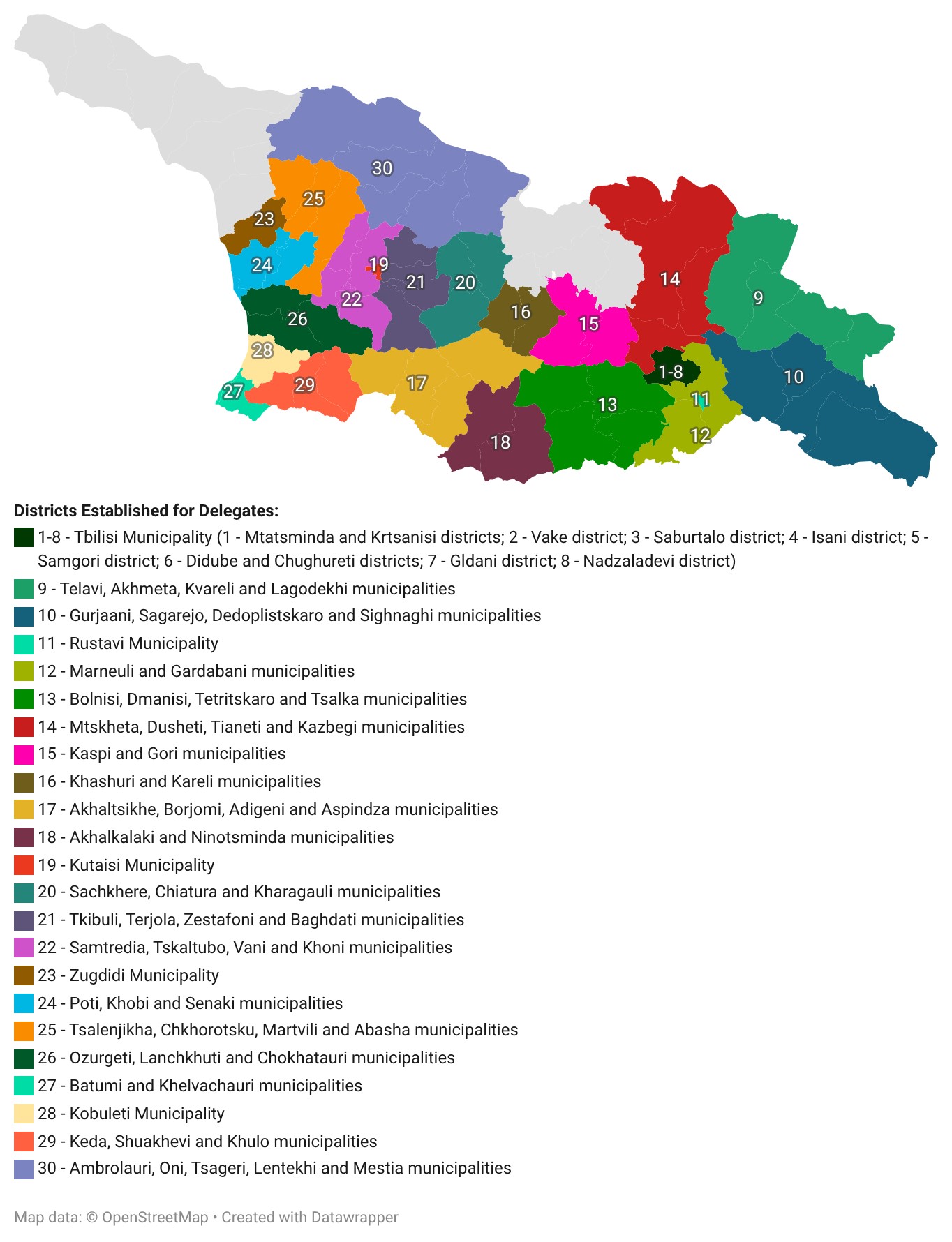
Under the rules set out in the Election Code by Georgian Dream, after the election, a member of the Parliament of Georgia nominated as a delegate candidate is considered the delegate for the relevant district if the party that designated them as its delegate candidate receives the most votes in that district.
Possible Conflict Between the District Delegate Institution and the Principles Established by the Constitution
According to the Constitution of Georgia, “Parliament shall consist of 150 members elected for a term of four years by universal, free, equal and direct suffrage, by secret ballot, under a proportional system in a single multi-member electoral district.” Thus, under the Constitution, the entire country constitutes one electoral district for parliamentary elections, and each member of Parliament can be elected only at the national level. In light of this constitutional provision, the establishment by an organic law of parallel boundaries for another type of district, where a member of the Parliament of Georgia is assigned a status based on voting results in a particular territory, may conflict with the relevant principles established by the Constitution. In addition, the rule set out by Georgian Dream in the Election Code provides for delegate status to be granted to only one person: the person included on the party list as the district’s delegate candidate by the party that receives the best result in that district. This replicates the single-member district principle, which is incompatible with a proportional electoral system.
According to the Oxford Handbook of Electoral Systems, when distinguishing proportional systems from plurality/majority systems, both the seat-allocation formula and district magnitude - the number of seats to be allocated in a district - are important. In most proportional systems, seats are allocated to party lists. In such cases, the core logic of proportional representation is to ensure correspondence between the votes parties receive and the seats they win. By contrast, electoral-system scholars define plurality as receiving the largest share of votes, which does not necessarily amount to an absolute majority. In such a system, the candidate who receives the most votes in a particular district wins. Accordingly, under a plurality/majority system, a district is usually single-member, whereas under a proportional system it is always multi-member. According to the New International IDEA Handbook on Electoral System Design, all types of proportional systems require electoral districts in which more than one member is elected, because “it is not possible to divide a single seat elected on a single occasion proportionally.”
Thus, the rule used to grant district delegate status, developed before the 2024 parliamentary elections, followed a principle characteristic of plurality/majoritarian systems: the candidate included on the party list by the party receiving the most votes in a particular territory was considered that territory’s delegate. As a result, two different logics operated within the single multi-member district: parliamentary seats were allocated proportionally nationwide, while delegate status was determined by which party received the most votes in a particular territory. The latter is based on a principle that does not correspond to the characteristics of proportional representation and is instead a feature of plurality/majoritarian systems.
At the same time, according to the assessment of the International Society for Fair Elections and Democracy (ISFED), this amendment, which was driven by the interests of the ruling party, misled voters and, within the existing fully proportional electoral system, had no institutional basis for a link between voters and candidates either in the voting process or in the allocation of seats. In addition to contradicting the spirit of the Constitution, the amendments Georgian Dream made to the Election Code had no international equivalent; as far as is known, a similar institution operates only in Georgia.
The Party-Political Basis for Introducing “District Delegate” Status and Its Use During the 2024 Pre-election Campaign
Georgian Dream's amendments to the Election Code, made several months before the 2024 parliamentary elections, also contradicted international electoral standards. In particular, according to the Venice Commission’s Code of Good Practice in Electoral Matters, it is unacceptable to change an electoral system frequently or directly before an election, during the final year before it. Such changes are considered driven by particular political interests, even when there is no intention to manipulate the process.
Georgian Dream likely sought in this way to preserve, to its own advantage, the contamination effect characteristic of a mixed-member electoral system. This psychological effect arises under a mixed-member electoral system with individual voting, when voters have two votes - one for the proportional component and another for the majoritarian component. In such cases, a voter’s assessment of a candidate can influence their choice in favour of a particular party, and vice versa: a candidate can help mobilise additional votes for the party as well.
Although the voting structure in the most recent parliamentary election was categorical rather than dividual, and voters cast a ballot only for their preferred political party, Georgian Dream used the so-called “delegate candidates” in an intensive election campaign and presented them to voters as a kind of successor to majoritarian MPs. Notably, in the 2024 parliamentary elections, only the ruling party, Georgian Dream, used the district delegate candidate institution. No opposition group nominated delegate candidates. Under these circumstances, the opportunities to use the institution for Georgian Dream’s electoral purposes were significantly expanded.
In the most recent parliamentary elections, the so-called “delegate candidates” were an important component of Georgian Dream’s election campaign, particularly in the regions, where the campaign was highly personalised. According to information Georgian Dream disseminated, the party’s nominated “delegate candidates” held 5,048 meetings over 50 days, averaging 170 meetings per candidate.
It is difficult to determine precisely what specific benefit the ruling party gained from introducing the district delegate institution and being the only party to use it. However, the ruling party’s stronger electoral performance in districts where incumbent majoritarian MPs were nominated as delegate candidates may indicate that the institution increased support for Georgian Dream. Specifically, according to the official results of the 26 October 2024 parliamentary elections, the ruling party received 60% of the vote in districts where majoritarian MPs elected in 2020 were nominated as Georgian Dream delegate candidates for the 2024 elections, compared with only 50% in other districts.
Establishment of “District Delegate” Offices and Their Funding from the Parliamentary Budget After the 2024 Parliamentary Elections
On 12 December 2024, the Georgian Dream parliamentary majority amended the Rules of Procedure of the Parliament of Georgia, thereby introducing the district delegate office. The stated purpose of establishing this institution locally was to organise a member of Parliament’s work with citizens, communication with relevant public institutions, and participation in resolving local issues. It was also established that the costs associated with the work of a district delegate office would be reimbursed from the parliamentary budget.
A regulation adopted on 13 December 2025 and approved by the Bureau of Parliament, upon submission by the Speaker of Parliament, set out the functions, organization, and operating procedures of a district delegate office, as well as its funding rules and amounts. The regulation defined the office’s functions as organising the delegate’s work with voters and the delegate’s participation in resolving local issues. Notably, the latter function, like the institution's existence, may conflict with the Constitution of Georgia. Specifically, under the Constitution, citizens of Georgia regulate matters of local importance through local self-government, and the division of powers between state authorities and self-governing units is based on the principle of subsidiarity. A self-governing unit is authorised, in compliance with the law, to make decisions on its own initiative on any matter that the law does not assign to the exclusive powers of state authorities or an autonomous republic, and on which the law does not exclude decision-making by the self-governing unit. Under the Constitution, a self-governing unit exercises its own powers independently and under its own responsibility, within the framework of Georgian legislation.
The regulation “On Determining the Functions, Organisation and Operating Procedures, as well as the Funding Rules and Amounts, of a District Delegate Office” also stipulates that the office:
- organises meetings with citizens; considers issues raised in citizens’ letters, complaints and applications; and prepares relevant conclusions and proposals for the delegate;
- registers, records, examines and responds to letters, complaints and applications submitted to the delegate;
- organises the delegate’s meetings with voters;
- assists the delegate in liaising with political groups and civic organisations, as well as the mass media;
- provides organisational and technical support to the delegate;
- forms part of the Parliament’s Office as a structural unit; within its competence, cooperates with structural units of the Parliament’s Office, parliamentary committees, factions and temporary commissions, as well as ministries, local self-government bodies, institutions and civic organisations;
- performs other functions necessary for the operation of the office.
Funding for district delegate offices consists of one-off material and technical funding and monthly funding. Each office receives a one-off allocation of GEL 5,000 for material and technical support and an additional GEL 3,000 for renewal if the inventory of the office from the previous parliamentary term is transferred to it. The monthly funding of an office is determined by the district coefficient: 2.5 for Tbilisi districts and districts comprising one or two municipalities, 3 for districts comprising three municipalities, and 4 for districts comprising four or five municipalities. In 2025, monthly funding was calculated by multiplying each coefficient by GEL 6,000. By a decision of the Bureau of the Parliament of Georgia dated 19 December 2025, funding for district delegate offices was increased. Specifically, to calculate the monthly funding amount, the amount corresponding to one coefficient was set at GEL 6,600 instead of GEL 6,000. As a result, the prescribed total annual funding for the offices increased by GEL 651,600 in 2026, reaching GEL 7,167,600.
Funding of District Delegate Offices as of 2026
|
District No |
Covered Territory |
District Delegate |
Annual Funding (GEL)a |
|
1 |
Mtatsminda and Krtsanisi districts of Tbilisi Municipality |
David Kacharava |
198,000 |
|
2 |
Vake District of Tbilisi Municipality |
Zurab Rurua |
198,000 |
|
3 |
Saburtalo District of Tbilisi Municipality |
Akaki Aladashvili |
198,000 |
|
4 |
Isani District of Tbilisi Municipality |
Nika Elisashvili |
198,000 |
|
5 |
Samgori District of Tbilisi Municipality |
Varlam Liparteliani |
198,000 |
|
6 |
Didube and Chughureti districts of Tbilisi Municipality |
George Volski |
198,000 |
|
7 |
Gldani District of Tbilisi Municipality |
Vladimir Bozhadze |
198,000 |
|
8 |
Nadzaladevi District of Tbilisi Municipality |
Irakli Kheladze |
198,000 |
|
9 |
Telavi, Akhmeta, Kvareli and Lagodekhi municipalities |
Irakli Kadagishvili |
316,800 |
|
10 |
Gurjaani, Sagarejo, Dedoplistskaro and Sighnaghi municipalities |
Gia Benashvili |
316,800 |
|
11 |
Rustavi Municipality |
Irakli Shatakishvili |
198,000 |
|
12 |
Marneuli and Gardabani municipalities |
Zaur Dargali |
198,000 |
|
13 |
Bolnisi, Dmanisi, Tetritskaro and Tsalka municipalities |
David Sherazadishvili |
316,800 |
|
14 |
Mtskheta, Dusheti, Tianeti and Kazbegi municipalities |
Dimitri Khundadze |
316,800 |
|
15 |
Kaspi and Gori municipalities |
Vladimer Khinchegashvili |
198,000 |
|
16 |
Khashuri and Kareli municipalities |
Zaal Dugladze |
198,000 |
|
17 |
Akhaltsikhe, Borjomi, Adigeni and Aspindza municipalities |
Anton Oboilashvili |
316,800 |
|
18 |
Akhalkalaki and Ninotsminda municipalities |
Samvel Manukyan |
198,000 |
|
19 |
Kutaisi Municipality |
Zaza Lominadze |
198,000 |
|
20 |
Sachkhere, Chiatura and Kharagauli municipalities |
Paata Kvijinadze |
237,600 |
|
21 |
Tkibuli, Terjola, Zestafoni and Baghdati municipalities |
Zviadi Shalamberidze |
316,800 |
|
22 |
Samtredia, Tskaltubo, Vani and Khoni municipalities |
Givi Chichinadze |
316,800 |
|
23 |
Zugdidi Municipality |
Edisher Toloraiab |
198,000 |
|
24 |
Poti, Khobi and Senaki municipalities |
Giorgi Khakhubia |
237,600 |
|
25 |
Tsalenjikha, Chkhorotsku, Martvili and Abasha municipalities |
Ilia Injia |
316,800 |
|
26 |
Ozurgeti, Lanchkhuti and Chokhatauri municipalities |
Vasil Chigogidze |
237,600 |
|
27 |
Batumi and Khelvachauri municipalities |
Archil Beridze |
198,000 |
|
28 |
Kobuleti Municipality |
Giorgi Tchkonia |
198,000 |
|
29 |
Keda, Shuakhevi and Khulo municipalities |
Anzor Bolkvadze |
237,600 |
|
30 |
Ambrolauri, Oni, Tsageri, Lentekhi and Mestia municipalities |
Gocha Enukidze |
316,800 |
|
Total |
7,167,600 |
||
Note: (a) The funding amounts include only the monthly allocations for district delegate offices and do not include amounts earmarked for material and technical support. (b) On 4 October 2025, Dato Kodua, the member nominated by Georgian Dream as the delegate for Zugdidi in the Parliament of Georgia, was elected Mayor of Zugdidi Municipality, after which his parliamentary mandate was terminated. In December of the same year, the Georgian Dream faction nominated Edisher Toloraia as the successor member of Parliament for the Zugdidi district delegate, and the Bureau of Parliament took note of the nomination. The decision was based on Article 226(4) of the Rules of Procedure of the Parliament of Georgia, according to which, if a district delegate’s parliamentary mandate is terminated before its expiry, the faction formed by the political party that nominated the district delegate designates, from among its members, the member of Parliament who succeeds the delegate.
Under the current version of the Rules of Procedure of the Parliament of Georgia, a district delegate is required to provide the Parliamentary Procedural Issues Committee with information on the expenses incurred by the district delegate office once a year, during the period from 15 December to 15 January. According to information published on the Parliament of Georgia’s website, 29 district delegates submitted such information in 2025. A total of GEL 6,411,769 had been allocated from the budget for these offices, of which GEL 5,517,822 was spent.
Amounts Allocated from and Spent from the Parliament of Georgia’s Budget for “District Delegate Offices” in 2025
|
District Delegate |
Amount Allocated from the Budget (GEL) |
Amount Spent from the Budget (GEL) |
Remaining Balance (GEL) |
|
David Kacharava |
185,000 |
177,449 |
7,551 |
|
Zurab Rurua |
188,000 |
181,935 |
6,065 |
|
Akaki Aladashvili |
185,000 |
162,649 |
22,351 |
|
Nika Elisashvili |
185,000 |
151,108 |
33,892 |
|
Varlam Liparteliani |
188,000 |
174,553 |
13,447 |
|
George Volski |
188,000 |
184,789 |
3,211 |
|
Vladimir Bozhadze |
188,000 |
166,211 |
21,789 |
|
Irakli Kheladze |
180,000 |
168,082 |
11,918 |
|
Irakli Kadagishvili |
288,000 |
268,204 |
19,796 |
|
Gia Benashvili |
288,000 |
267,733 |
20,267 |
|
Irakli Shatakishvili |
157,121 |
148,332 |
8,789 |
|
Zaur Dargali |
180,000 |
159,711 |
20,289 |
|
David Sherazadishvili |
296,949 |
276,389 |
20,560 |
|
Dimitri Khundadze |
288,000 |
162,196 |
125,804 |
|
Vladimer Khinchegashvili |
185,000 |
162,039 |
22,961 |
|
Zaal Dugladze |
165,000 |
155,269 |
9,731 |
|
Anton Oboilashvili |
288,000 |
248,175 |
39,825 |
|
Samvel Manukyan |
180,000 |
130,758 |
49,242 |
|
Zaza Lominadze |
180,000 |
164,347 |
15,653 |
|
Paata Kvijinadze |
221,000 |
195,873 |
25,127 |
|
Zviadi Shalamberidze |
292,951 |
174,383 |
118,568 |
|
Givi Chichinadze |
288,000 |
272,533 |
15,467 |
|
Giorgi Khakhubia |
221,000 |
169,257 |
51,743 |
|
Ilia Injia |
280,159 |
241,347 |
38,811 |
|
Vasil Chigogidze |
230,000 |
163,199 |
66,801 |
|
Archil Beridze |
191,000 |
173,251 |
17,749 |
|
Giorgi Tchkonia |
188,000 |
178,096 |
9,904 |
|
Anzor Bolkvadze |
221,367 |
193,391 |
27,976 |
|
Gocha Enukidze |
295,222 |
246,563 |
48,659 |
|
Total |
6,411,769 |
5,517,822 |
893,947 |
Under the regulation established by the Bureau of the Parliament of Georgia, the funds allocated from the parliamentary budget for a district delegate office cover the costs of communication services, fuel, vehicle rental, routine non-capital repairs to the office premises, and the purchase of fixed assets required for the office to operate. The regulation also provides for representation expenses for voters on public holidays or during meetings with voters, as well as “other expenses necessary for the operation of the office.”
In addition to directly funding district delegate offices, the Office of the Parliament of Georgia also funds office rentals and pays the salaries of employees hired under administrative contracts.
A significant part of a district delegate office's prescribed activities overlaps substantially with a political party's local organisational and electoral activities. Receiving citizens and voters and organising meetings with them, examining their requests and problems, liaising with civic and political organisations, and providing organisational and technical support for the delegate’s political activities are functions that serve parties’ communication with voters and efforts to secure political support. Accordingly, considering the functions assigned to the office and its funding from the state budget, there are further grounds for a reasonable concern that activities which substantively serve party goals and objectives are being supported with state resources under the guise of parliamentary representation.
Alternative Options for Ensuring Territorial Representation Under a Proportional Electoral System
The transition to a proportional electoral system does not rule out the need to maintain representative links between members of Parliament and specific territories. On the contrary, particularly in a single electoral district with an extensive geographical coverage, voters may expect their interests to be represented in Parliament not only through party representation but also through mechanisms linked to particular territories. However, ensuring such a link does not require creating, within a proportional system, a parallel institution based on the majoritarian principle. Mechanisms can provide territorial representation without linking it to the electoral or organisational interests of any particular political party.
One possible approach is to use electoral districts in which several seats are allocated within a proportional system. In international electoral practice, district magnitude is an important factor affecting the strength of the link between representatives and voters. In this respect, relatively small multi-member districts could uphold the principle of proportional representation while maintaining a clearer territorial link between voters and elected representatives.
Accordingly, the need for territorial representation cannot, in itself, provide sufficient justification for the existence of the “district delegate” institution. The question is rather how such representation should be ensured: through a mechanism that is consistent with the logic of a proportional electoral system and equally accessible to political forces, or through an institution that grants special status to the party that wins in a particular territory and that, in the 2024 election, could be used only by Georgian Dream.
Conclusion
The creation of the “district delegate” institution, its use in the 2024 parliamentary elections, and the subsequent funding of delegate offices from the state budget are interconnected processes linked to the use of legislative and financial-administrative resources to advance the ruling party's political objectives. Implementing this arrangement at all three stages helped advance the electoral and party-political objectives of the ruling force.
At the first stage, under a fully proportional electoral system, an institution of 30 district delegates was created. Their areas of operation were largely defined by the boundaries of the single-member districts used in previous elections, which had been represented only by Georgian Dream MPs. Although under the Constitution of Georgia, Parliament is elected by a proportional electoral system in a single multi-member district, an amendment introduced by Georgian Dream into the Election Code several months before the 2024 parliamentary elections provided that a person designated on its party list as a “delegate candidate” by the party receiving the most votes in a particular territory would simultaneously be granted “district delegate” status. Thus, a parallel mechanism of territorial representation was created within a proportional system. Its logic approaches a plurality/majoritarian system and raises questions about its compatibility with the electoral model established by the Constitution.
At the second stage, only Georgian Dream used the institution in the 2024 parliamentary elections, actively involving “delegate candidates” in the pre-election campaign. This created the possibility of equating “delegate candidates” with majoritarian MPs, whom Georgian citizens had elected for 30 years. A single party’s use of the institution further strengthened Georgian Dream’s ability to mobilise votes.
At the third stage, after the election, delegates received offices funded with state resources. The offices were assigned functions including organising meetings with voters, examining their requests and problems, liaising with civic and political organisations, and providing organisational support for the delegate’s political activities. The parliamentary budget allocated approximately GEL 13.6 million for these purposes in 2025–2026. Notably, a significant part of the assigned functions substantively overlaps with the activities of local political party organisations. Accordingly, funding these offices from the state budget is particularly problematic given that the institution’s constitutional compatibility is in question and that the mechanism created by Georgian Dream before the most recent parliamentary elections was used only by that party itself.
Under international standards, state financial, administrative, and institutional resources should serve public purposes and should not create an electoral or organisational advantage for any political force. It is therefore problematic to use state resources for activities that, in substance, resemble party-political communication and organisational work and serve to mobilise votes for the ruling party.
It should also be noted that the function assigned to “district delegate offices” of participating in the resolution of local issues raises a further question about the constitutionality of the institution. According to the Constitution of Georgia, local self-government manages local affairs, and the powers of state authorities and local self-government bodies are separated. It is therefore unclear how a member of the Parliament of Georgia is expected to participate in resolving local issues and which matters the regulation governing the delegate’s